According to Patsy Rodenburg, all great performers have Presence. In fact, it is not possible to be a great performer without Presence. Or a great teacher. Or a great leader. But what is Presence? It is an exchange of energy between a person and another person, or the world – that achieves connection.

Who is Patsy Rodenburg?
Patsy Rodenburg OBE is widely regarded as one of the world’s leading voice coaches and teachers. Over a career of more than 40 years, she has worked at the Royal National Theatre and the Guildhall School of Music and Drama, and coached many of our finest British actors, including Dame Judi Dench, Sir Ian McKellen and Ewan McGregor.
Having trained as an actor before moving into voice coaching, Patsy combines textual principles found in Shakespeare with the study of breath, body and voice. She has made her passion her life’s work – bringing people back to a full experience and command of their natural voice and presence through breath, body and vocal preparation.
Patsy’s method transforms a person’s speaking impact, and brings fresh energy to many areas of their personal and professional lives.
Presence
Early in her voice teaching career Patsy was upset by colleagues who would say of their students in a definitive, dismissive way, ‘He’s got it.’ Or ‘She hasn’t got it.’ What was ‘It’? Patsy discovered that it is an energy we all have, and she calls it Presence.
‘Presence is a universal quality we all have…’It’ is an ‘It’ that we all have locked away in our bodies and breath that can be awakened.’
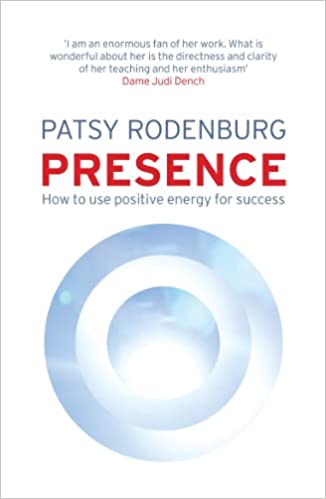
In her popular book Presence: How to use Positive Energy for Success in every Situation Patsy identifies three basic ways in which human energy moves between people, which she illustrates by three circles.
- First circle – self-absorption and withdrawal: we absorb or block other people’s energy and draw all outward stimuli inward.
- Second circle – energy focused on connection: an exchange of energy, where we move towards the object of our attention, touch it, and receive the energy required back. We are connected; we experience the give and take of being present.
- Third circle – bluff and force: our energy is focused outwards, either non-specifically or targeted with force, motivated by control.
We operate within all three circles of energy, and can move rapidly between them, depending on the social situation we find ourselves in. The time we spend or reasons for being within the energy of a particular circle may be influenced by life circumstances or simply, by our instinctive response to the moment.
We may find ourselves in the first circle, closed down, because we have been belittled by a colleague, undermined, victimised. Or we have chosen to withdraw for reflection, or to rest and recoup our energy.
We may need to push into the third circle to respond to a crisis, to bring order to a life or death event. Or we choose to assert our position or state our case loudly in situations that threaten to overwhelm us.
Living in the second circle

For Patsy, to live in the second circle is Presence. It is the continual sense of being present and we make an ongoing choice to stay present. She believes we are born in the second circle – fully alert, with a sense of aliveness and innate hope. It is where we are most ourselves, in our natural state. When we have been defeated and our Presence gets lost, we can find it again and cultivate it across every area of our life.
In the second circle, we:
- are in the present moment
- are alert and centred, breathing well
- feel connected, confident and aware
- know we are right to be where we are
- are engaged, fully connected with the subject
- can listen generously and attentively
- feel curious rather than judging
- are free to influence and be influenced
- experience the give and take of being present and connected
- speak from the authority of our own experience
Living in the second circle needs to be cultivated with intention, awareness and practice. Presence can be diminished by constant negativity, or careless habits, but it thrives on joy developed in a safe environment.
While we need all three circles, and we tend to move between them, Patsy says that every great performer – and leader – should live in one circle all the time, and that is the second circle.
Let’s hear from Patsy herself in the video below.
Leading from the second circle
Patsy believes her methodology and philosophy can be applied across many areas of life, including in leadership. Leaders who lead from the second circle understand the importance of cultivating their physical voice to maximise their speaking impact and presence.
But Presence goes much deeper; it is to harness the energy of voice, mind and heart. It is to lead from a place of confidence and self-awareness, to work on the basis that you are ‘there’, in the moment. You are the right person, in the right place, fully engaged to fulfil your responsibilities and with your people. Leading from the second circle is a commitment to connection, to an exchange of energy between yourself and another person that is its own unique success.
About us
We are a team of highly experienced executive coaches, focused on developing leaders working in high-stakes environments across diverse sectors. We create space for leaders to step back, think clearly, and navigate complexity with confidence and renewed purpose. Our narrative-based approach blends deep listening, incisive questioning and rigorous thinking with a strong commercial focus.
“Our Knowledge Centre is designed to resource leadership practice and development. The articles we share on this site are intended to spark fresh thinking, offer practical tools, and support continuous professional growth.”
Jude Elliman
Founder
Our approach
We work with leaders to build their leadership brand and impact. Our approach includes:
✔ Challenge and support: creating time and space for rigorous thinking and problem-solving
✔ Narrative coaching: defining and refining the stories that shape leaders and organisations
✔ Commercial focus: cutting through complexity for strategies that inspire change and drive results
We help leaders make crucial decisions, align teams for greater effectiveness, and envision new possibilities for the future.